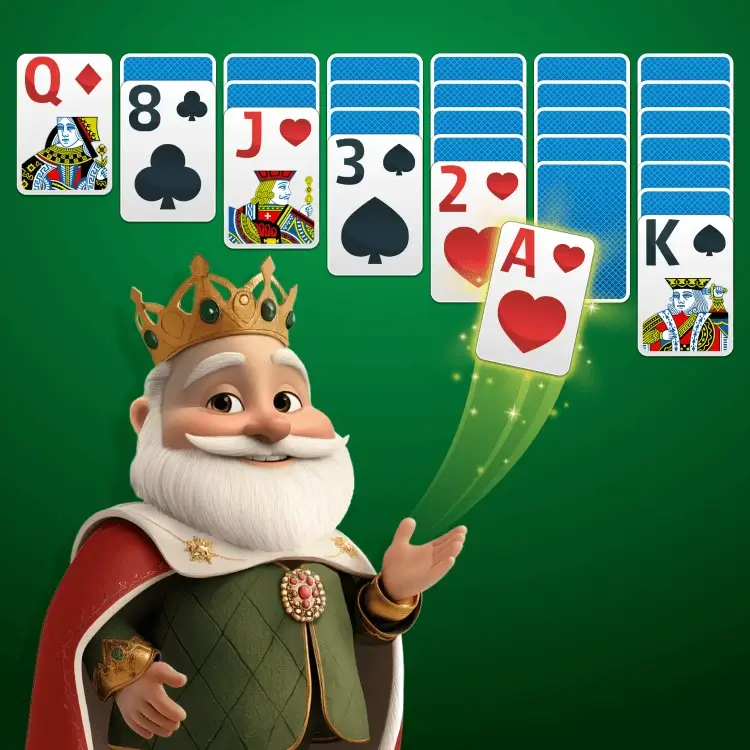
What Is Triple Klondike?
Three standard decks are shuffled together into one game. A hundred and five cards go onto the table in fourteen columns, from one card to fourteen, and a fifteenth column is left open. The remaining fifty-one wait in the stock.
Twelve foundations sit along the top - three for every suit - and each is filled from Ace to King exactly as in the classic game. Any Ace of a suit can open any of that suit's three piles, and it does not matter which.
Twelve Foundations Are the Whole Difficulty
In one-deck Klondike you can hold the state of the game in your head. Here you cannot, and that is the honest reason Triple Klondike feels harder than it looks on paper - not the card count, but the number of places a card might belong.
A red 7 turning up in the waste can go to three different foundations or onto any black 8 on the table, and there may be three of those. Every turn offers more choices than the last one, and most of them are slightly wrong. Players who lose here rarely run out of moves; they run out of attention.
The board rewards a habit rather than a trick: before you touch anything, look at what the move buries. With fourteen columns, burying is the mistake that costs games.
How to Play Triple Klondike
The objective is to move all 156 cards onto the twelve foundations, each sorted by suit from Ace to King.
- Fourteen columns are dealt in a staircase, one to fourteen cards, and a fifteenth starts empty. Only the top card of each column is face up.
- Build down the table in alternating colours, and move ordered sequences together.
- An empty column takes a King, or a sequence headed by one. Twelve Kings are in play, so free columns fill quickly.
- Foundations start with Aces and build up by suit, three piles per suit, twelve in all.
- Turn the stock one card or three, and go through it as many times as you like.
- The game is won when all twelve foundations run from Ace to King.
Playing Three Decks Well
- Work the long columns. The fourteenth buries thirteen cards, and the game does not really begin until they start turning over.
- Send cards up late rather than early. With three copies of every card, a 4 on the foundation is rarely urgent, and on the table it may be holding a whole sequence together.
- Do not open a column you cannot fill. An empty column with no King in sight is a hole in the middle of the board.
- If you play turn three, count your passes. The stock is fifty-one cards deep, and a careless pass through it costs more here than in any smaller game.
Other Solitaire Games to Try
Double Klondike
Double Solitaire is the same game one deck smaller: ten columns, eight foundations, and far easier to hold in your head.
Klondike Solitaire
Klondike Solitaire is where all of this comes from - one deck, seven columns, four foundations.
Pyramid Solitaire
Pyramid Solitaire swaps building for arithmetic: clear the pyramid by pairing cards that add up to 13.