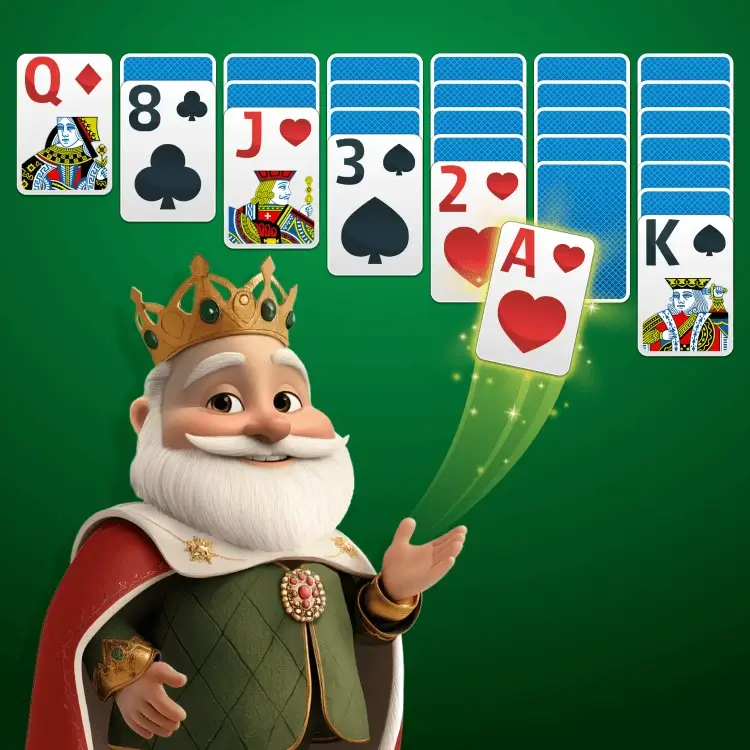
Double Solitaire and Double Klondike Are Not the Same Game
The name is shared by two different games, and it is worth knowing which one you are looking for before you sit down to play.
Double Solitaire, in the older sense, is a game for two people. Each player lays out their own Klondike and the two share the foundations in the middle - whoever plays a card there first gets it. It is a race, and it needs a partner, a table and two physical decks.
Double Klondike, also called Gargantua, is the solo game on this page. One player, one table, two decks shuffled together into a single layout. Nobody is racing you, and the size of the board is the whole point.
Most people searching for double solitaire online want the second one, because the first cannot be played alone. That is what you get here.
How to Play Double Klondike
The objective is to move all 104 cards onto the eight foundations, each sorted by suit from Ace to King. Cards travel from the table and the waste pile to the foundations, and back down onto the table when a sequence needs building.
- Ten columns are dealt in a staircase, one to ten cards, and an eleventh column starts empty. Only the top card of each column starts face up.
- On the table, build down in alternating colours: a red 9 takes a black 8, a black 10 takes a red 9. Ordered sequences move together.
- An empty column takes a King, or a sequence that starts with one.
- The eight foundations start with Aces and build up by suit. Two decks mean two foundations per suit, and either Ace of a suit can open either pile.
- Turn the stock one card at a time or three at a time - the choice is yours, and it changes the game more than the extra deck does. When the stock runs out, the waste returns to it as often as you need.
- The game is won when all eight foundations are complete, from Ace to King.
Two Decks Change the Odds in Your Favour
Single-deck Klondike ends in a dead position more often than most players expect. With 104 cards there are roughly twice as many legal moves available at any moment, so a table that looks locked usually is not - somewhere on it a card still fits.
What you pay for that is bookkeeping. Two black Kings, two red Aces, two of every card you are waiting for, and eight piles to keep straight instead of four. The difficulty moves out of the shuffle and into your attention.
Four Habits That Win Double Klondike
- Uncover face-down cards before anything else. Ten columns hide more cards than seven, and a move that reveals one is worth more than a move that only tidies.
- Hold cards back from the foundations. A 6 sent up early can be exactly what a 5 needed on the table - and with a duplicate of every card in play, holding one back costs you less than it would in the single-deck game.
- Ration your empty columns. Eight Kings are looking for a home, and filling the only free column with the wrong one is the most common way a promising game stalls.
- Dig into the tenth column first. Nine cards are buried under it, and nothing behind them can help you until they come out.
Other Solitaire Games to Try
Triple Klondike
Triple Solitaire takes the same idea one step further: three decks, fourteen columns, twelve foundations.
Mini Solitaire
Mini Solitaire goes the other way - the Queens and Kings come out, leaving 44 cards and a game you can finish in a few minutes.
Spider Solitaire
Spider Solitaire also deals two decks, but it builds by suit across ten columns and has no waste pile at all.